Pull out your phone and search "coffee shop near me." See that little map at the top with three businesses listed below it? That's the Google Maps 3-pack, and it's the most valuable real estate in local search. If your business is one of those three, you're getting the lion's share of calls and visits. If you're not, most customers will never know you exist.
Why only three? And why does it matter so much?
Google used to show seven local results. Then they cut it to three. On a phone screen — where most local searches happen — those three results take up almost the entire screen. A customer sees the map, the three businesses with their star ratings and distance, and that's it. Most people pick one of the three and call or visit without ever scrolling further.
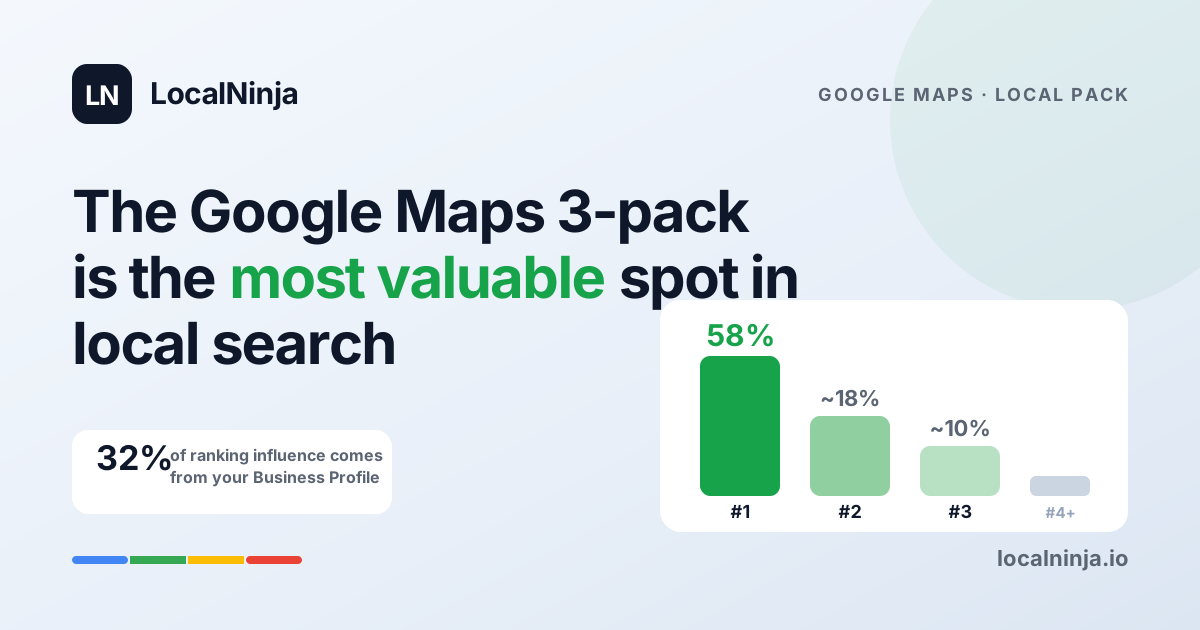
The numbers back this up: the top result in the 3-pack gets between 44% and 58% of all clicks. The second and third spots split most of what's left. Business number four? It sits behind a "More places" link that most people never tap. Being in the top three versus being number four is the difference between your phone ringing and silence.
Here's the thing most business owners get wrong
Many business owners assume the 3-pack is pay-to-play, or that it always goes to the biggest company in town. Neither is true. Google doesn't sell those three organic map spots — they're earned. And in 2026, smaller businesses with well-maintained profiles are consistently outranking larger businesses that neglect theirs.
Your Google Business Profile signals account for 32% of your ranking influence — the single biggest factor Google uses to decide who gets in the 3-pack. Not your website. Not your ad budget. Your profile. That's incredibly empowering, because it's something you directly control.
The three things Google actually cares about
Google has been pretty transparent about the three main factors that determine 3-pack rankings. They're simpler than you might think:
- Relevance — Does your profile clearly describe what you do? If someone searches "emergency plumber" and your profile just says "plumbing," you're less relevant than the competitor who listed "emergency plumbing" as a specific service.
- Distance — How close is your business to the person searching? You can't change your location, but you can make sure your address is accurate and your service area is properly defined.
- Prominence — How well-known and active is your business online? This is where reviews, photos, posts, and citations all come into play.
You can't do much about distance — your shop is where it is. But relevance and prominence? Those are entirely in your hands. And they're two-thirds of the equation.
Engagement signals: the new ranking factor nobody's talking about
Here's what changed in 2026 that most people haven't caught up to yet: Google now heavily weights engagement signals. That means how many people view your photos, read your reviews, click on your Q&A section, and visit your website from your profile. It's not just about having a profile — it's about having a profile people interact with.
This is a massive shift because it rewards businesses that put effort into their profiles, regardless of how big they are. A solo dentist with 200 thoughtful reviews and 80 photos of their office can outrank a dental chain with 15 locations but a bare-bones profile. Google is measuring whether real people find your profile useful, and that's great news for small businesses that actually care.
Reviews: it's not just about the stars
Yes, a high star rating helps. But Google looks at more than just the number. Review velocity — how often new reviews come in — is a ranking signal. A business that got 50 reviews three years ago and nothing since looks stale compared to one that gets two or three reviews a week.
Your response rate matters too. Google tracks whether you reply to reviews and how quickly. Responding to every review — positive and negative — signals that you're an engaged, active business. It also builds trust with customers who read those responses before deciding to call you.
Think of reviews as a conversation, not a scoreboard. Google rewards businesses that treat them that way.
Photos: most businesses dramatically underinvest here
Profiles with 50 or more photos significantly outperform profiles with fewer than 10. That's not a typo — fifty photos. It sounds like a lot, but think about it: photos of your storefront, your team, your products, your work in progress, finished projects, happy customers (with permission), your equipment, your office, seasonal displays. A restaurant could hit 50 photos in an afternoon.
Photos do double duty. They're a ranking signal that tells Google your profile is active and complete. But they also keep customers on your profile longer, which boosts those engagement signals we talked about. Someone scrolling through 30 photos of your beautifully plated dishes is sending Google a strong signal that your profile is worth showing to others.
The 30-day rule: what happens when you go quiet
Profiles that go more than 30 days without any activity see measurable drops in impressions. Google interprets silence as a sign that a business might not be actively operating — or at least isn't prioritizing its online presence. And if you're not prioritizing it, Google won't either.
Activity means posting updates, adding photos, responding to reviews, answering questions, or updating your business information. Even small actions count. A quick weekly post about a seasonal special or a behind-the-scenes photo keeps your profile fresh in Google's eyes. Think of it like watering a plant — a little bit regularly is better than flooding it once a quarter.
Posts: your secret weapon for weekly freshness
Google Business Profile lets you publish short posts — think of them like mini social media updates that appear right on your profile. Weekly posting provides fresh ranking signals that tell Google you're active. You can share offers, announce events, highlight a product, or just post a photo with a quick update.
Most of your competitors aren't doing this. Seriously — go look at the profiles of businesses in your area. The majority haven't posted in months, if ever. Posting once a week puts you ahead of probably 90% of the local competition. It takes five minutes and costs nothing.
NAP consistency: the boring thing that quietly kills rankings
NAP stands for Name, Address, Phone number. It needs to be exactly the same everywhere your business appears online — your Google profile, your website, Yelp, Facebook, the local chamber of commerce directory, industry-specific directories, everywhere. Not close. Exact.
If your Google profile says "123 Main Street" but Yelp says "123 Main St." and your website says "123 Main St, Suite A," Google sees three potentially different businesses. These inconsistencies erode trust in your listing and hurt your ranking. It's tedious to fix, but it's one of the highest-impact things you can do.
The "near me" reality: customers decide from the search page
Here's something that might change how you think about all of this: for most "near me" searches, the customer makes their decision right on the Google search results page. They look at the 3-pack, check the star rating, glance at the photo, maybe tap to read a couple reviews, and then they call. They never visit your website.
That means your Google Business Profile isn't just a listing — it's your storefront. For a huge chunk of your potential customers, it's the only impression of your business they'll ever see. If it's incomplete, outdated, or has no photos, that's like having a dusty, dark shop window on Main Street. People walk right past.
A quick checklist to start climbing into the 3-pack
- Fill out every single field in your Google Business Profile — services, attributes, hours, description, all of it
- Add at least 50 quality photos (and keep adding new ones monthly)
- Respond to every review within 24 hours, positive or negative
- Post a weekly update — a photo, a tip, a special offer, anything
- Make sure your business name, address, and phone number are identical across every website and directory
- Choose specific, accurate categories and services (don't be vague)
- Ask satisfied customers for reviews regularly — a steady trickle beats a one-time push
- Answer questions in the Q&A section of your profile
Want to know where your profile stands right now?
If you're not sure whether your profile is set up to compete for the 3-pack — or you suspect it has gaps that are holding you back — LocalNinja offers a comprehensive profile audit of your Google Business Profile. We'll look at your reviews, photos, posts, categories, and NAP consistency, then give you a clear, jargon-free report on exactly what to fix. It takes two minutes to request and might be the most useful thing you do for your business this week.