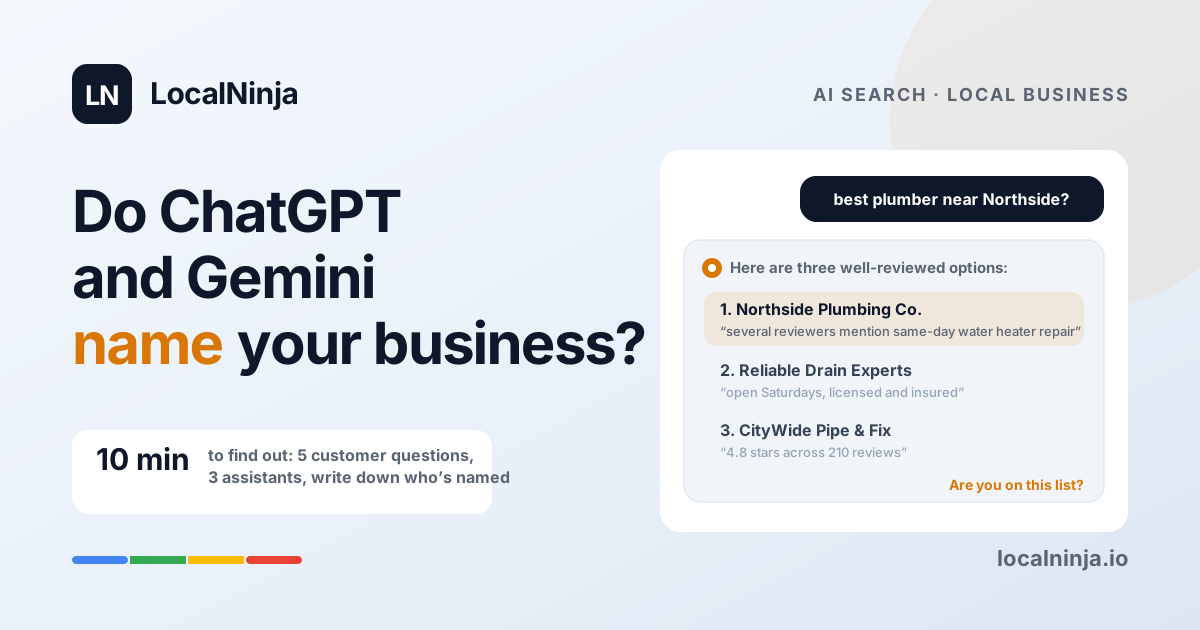
A customer with a leaking water heater used to type “plumber near me” into Google and tap one of the three pins. More of them now type the same question into ChatGPT, or ask Gemini, or let Google’s AI Mode answer before they ever see a map. The assistant replies with two to five business names and a sentence on each. If yours is one of them, your phone rings. If it is not, you never find out the customer existed. This guide is about getting on that short list.
Where AI assistants get their answers for local questions
None of the assistants has a secret list of good plumbers. When someone asks a local question, they look things up, much like a careful person would, and summarize what they find. From what we see when we run these checks for businesses, the sources fall into three groups.
- Google’s own data. Gemini and AI Mode lean heavily on Google Business Profiles — the category, the description, the hours, the rating, the reviews. ChatGPT reaches the same facts through the pages it reads.
- Pages on the open web that list or describe local businesses: directories like Yelp and the Better Business Bureau, local “best of” lists, neighbourhood news sites, your own website.
- Reviews, quoted. The assistants often repeat a line from a customer review as the reason to recommend a business — “several reviewers mention same-day service” — so what your customers write about you shapes the answer.
The practical consequence: the assistants recommend businesses that are easy to describe. If your profile and your website make it obvious what you do, where, and for whom, you are easy to recommend. If they do not, you are easy to skip.
First, find out whether they name you
You can do a rough version of this yourself in ten minutes. Write down five questions a customer would ask — “best emergency plumber in [your town]”, “who does water heater replacement near [neighbourhood]”, “plumber open on Sunday in [town]”. Ask each one in ChatGPT, in Gemini, and in Google with AI Mode on. Write down which businesses are named each time. Then do it again on another day, because the answers move around.
Two things to know about this test. The assistants’ answers depend on the location they think you are in, so do it from your service area, or tell the assistant where you are. And a handful of questions is a sample, not a verdict — it tells you whether you are in the conversation, not your exact share of it. The measured version in LocalNinja’s profile audit asks the real apps dozens of your customers’ questions and counts how often you come up against the businesses around you, then shows you the exact sentences the assistants used.
What makes a local business easy to recommend
- A category that matches the words people use. If customers say “emergency plumber” and your primary category is “Contractor”, the assistant has to guess. Set the primary category to the thing you most want to be found for, and add the specific secondary ones.
- A description that says what you do, where, and for whom in plain sentences. “Family-run plumbing company serving Northside and Riverview since 2009. Same-day repairs, water heaters, drain cleaning. Open Saturdays.” That paragraph is quotable. A list of keywords is not.
- Reviews that mention the service. Ask happy customers to say what you did for them. “Fixed our water heater the same afternoon” gives the assistant a reason to name you for water heater questions. A bare five stars does not.
- A website that says the same facts as your profile. Name, address, phone, services, hours and area — in text, on the page, not in an image or a PDF. When the two disagree, the assistant trusts neither.
- Being on the sites the assistants read. If a local “best plumbers” list or a directory the assistant leans on does not include you, you are missing from the answer before it is written. The audit’s “Sites AI uses” section shows which sites were looked at for your trade and whether you were found there.
Write for a reader, and the machines follow
Everything that helps an assistant recommend you also helps a person choose you, so there is no separate “AI version” of your website to build. Three additions do most of the work. A page per service, each saying plainly what it is, what it costs or how pricing works, and where you offer it. A questions page that answers, in full sentences, the things customers ask on the phone — do you charge for a quote, do you work weekends, do you handle insurance claims. And a short block of structured data on your site (your developer will know it as LocalBusiness schema) that states your name, address, phone, hours and service area in a form machines read without guessing.
What not to do
- Do not add keywords to your business name on Google. “Joe’s Plumbing — Best Emergency Plumber Northside” is against Google’s rules and is a common reason listings get suspended. The assistants do not reward it either.
- Do not buy reviews. Review platforms and Google filter them, and a batch of generic five-star reviews on one day is easy to spot — for people as well as machines.
- Be careful with anyone selling a package that promises a position in AI answers. Nobody can promise that; the answers change by question, by location and by day. Pay for measurement and for the fixes, not for a rank.
How to track it without obsessing over it
Check once a month, with the same questions, and write the results in the same place. Expect uneven progress: you may appear for one question and not the next, or in Gemini and not in ChatGPT, for a while. What you are looking for is the trend over three or four months. If you fix the category and description, gather a dozen specific reviews and get your site saying the same facts as your profile, that trend tends to move. Your Google Maps ranking still matters as much as it ever did — the assistants draw on the same signals, so the work compounds rather than competes.
If you would rather have the measurement done for you, LocalNinja’s profile audit includes an AI visibility section: how often ChatGPT, Perplexity and Gemini name you for your customers’ questions, what they say when they do, and which sites they looked at — alongside your map grid and the rest of your profile.