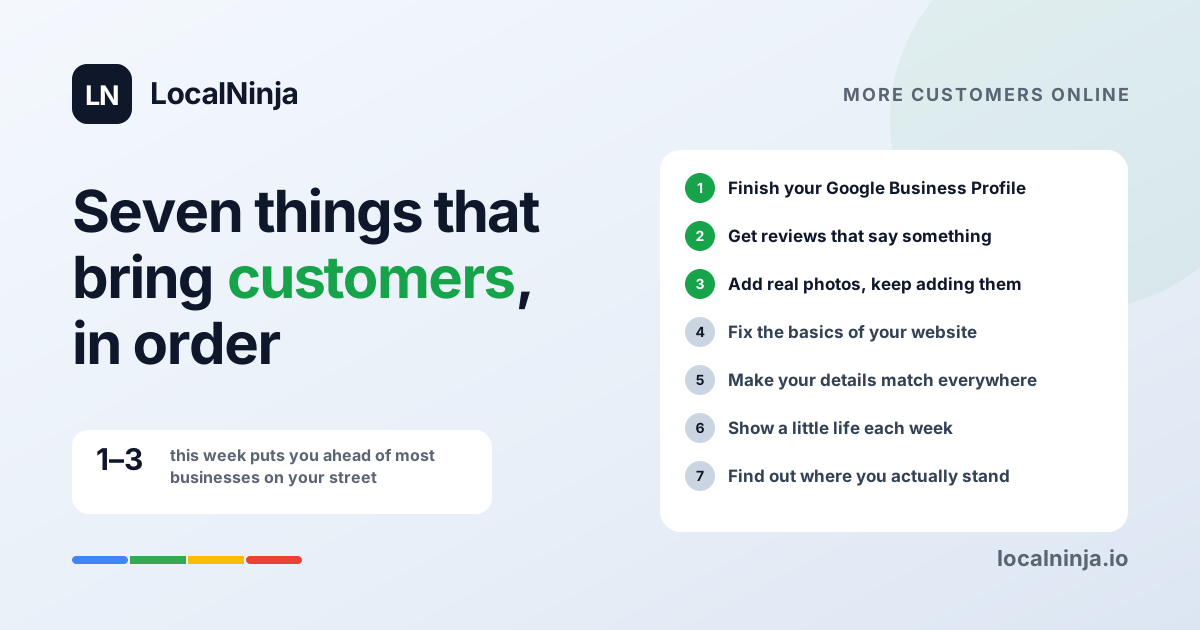
Most advice about getting customers online is written for companies with a marketing department. You run a shop, a practice or a van, and you have an hour on a Tuesday evening. So here is the version for you: the seven things that decide whether a nearby person finds you and picks you, in the order that pays off fastest. Do the first three and you are ahead of most businesses on your street.
1. Finish your Google Business Profile
When someone searches for what you do, Google answers with a map and three listings before any website. That listing is your Google Business Profile, it is free, and most owners have about half of it filled in. Completing it is the single highest-return hour you can spend.
- Set the primary category to the exact thing you want to be found for, and add every secondary category that truly applies.
- Fill in services, hours (including holidays), and the description — a few plain sentences on what you do, where, and for whom.
- Check the name, address and phone are exactly right, with no extra words in the name.
2. Get reviews that say something
Your rating and review count sit next to your name in every search, and people compare them with the businesses above and below you. Recency matters too: a profile whose last review is eight months old reads as closed or coasting. You do not need hundreds. You need a steady few each month, and you need them to mention the actual service, because “fixed our boiler the same day” persuades a reader and gets quoted by AI assistants, where five bare stars do neither.
- Ask at the moment the customer is happiest — when the job is done and they thank you.
- Make it one tap: a short link or a QR card at the counter that opens your Google review form.
- Reply to every review within a few days, by name, in a sentence or two. People read the replies.
3. Add real photos, and keep adding them
Photos are how a stranger decides whether to trust you before they call. Four kinds do the work: the outside (so they can find you), the inside (so they know what to expect), the people (so they know who they will meet), and the work (so they can see you can do it). Take them on your phone in daylight. Skip stock images; people can tell. Then add a few new ones every month, so the profile looks like a business that is open and busy.
4. Fix the basics of your website
You do not need a new website. You need the one you have to do four things: load quickly on a phone, say the same name, address and phone as your Google profile, name your services and your area in plain text, and make it one tap to call or book. If your site is slow, most of the fix is usually oversized images; a developer can shrink them in an afternoon. If you have no website at all, a single clear page with those facts is better than nothing, and it gives Google and the AI assistants something to confirm your profile against.
5. Make your details match everywhere
Search your business name and look at every listing that comes up — Yelp, Facebook, Apple Maps, the Better Business Bureau, the local chamber, old directories you forgot about. If one says “ABC Plumbing & Heating Inc.” and another says “ABC Plumbers” with an old phone number, Google and the assistants see a muddle and trust the whole set less. Pick one exact format for name, address and phone and make every listing match it. It is dull work, and it is worth doing once, properly.
6. Show a little life each week
Google favours profiles that look tended. A short post on your profile every week or two — a job you finished, a seasonal reminder, changed hours, a new service — takes five minutes and keeps the listing fresh. Answer the questions people leave on your profile, and add your own common questions with the answers, so the next person does not have to ask. None of this needs to be clever. It needs to be regular.
7. Find out where you actually stand
Everything above is easier to prioritise when you can see your own gaps. Open your profile’s Performance tab once a month and look at how many people searched, called and asked for directions. Then, a couple of times a year, get a proper picture: where you rank on Google Maps across your area (rank changes block by block, and the view from your own shop flatters you), who ranks above you and why, and whether ChatGPT and Gemini name you when people ask. A local SEO audit does that in one go and hands you the next three things to fix. Do them, wait a month, look again.
What about ads, social media and a new website?
They can all help, after the seven things above. Ads send people to your listing and your site, so a half-finished profile wastes the money. Social media works for some trades and not others, and it is a habit more than a tactic. A new website is rarely the bottleneck; the basics in step four usually are. If you have the seven done and some budget left, a small Google Ads test for your highest-value service is the most measurable next step.
How to know it is working
Count the things that matter: calls, direction requests and bookings from your profile’s Performance tab, and the new customers who say “I found you on Google”. Expect the first movement in the weeks after you finish steps one to three, and steadier growth over a few months as reviews and photos build up. If nothing moves after two months, something in the basics is still off — usually the category or a mismatch between the profile and the website — and that is exactly what an audit is for.
If you want the starting picture before you begin, LocalNinja’s profile audit shows your map ranking across your area, your reviews and photos next to the businesses above you, your AI visibility, and the three fixes to make first — for one payment, with nothing to install and no password to hand over.