A local SEO audit is a check of everything that decides whether a nearby customer finds your business on Google and, increasingly, in AI answers: your Google Business Profile, where you rank on Google Maps across your area, your reviews and how you reply to them, the basics of your website, and the businesses that show up above you. A good audit ends with a short list of fixes in the order that matters, written so you can do them yourself. This guide explains what should be inside one, what a fair price looks like, and how to read yours without getting lost.
What a local SEO audit actually checks
Regular SEO is mostly about your website. Local SEO is mostly about your Google Business Profile — the listing with your pin, photos, hours and reviews — because for a “plumber near me” search, Google answers with that listing before anyone reaches a website. So the audit starts there and works outward.
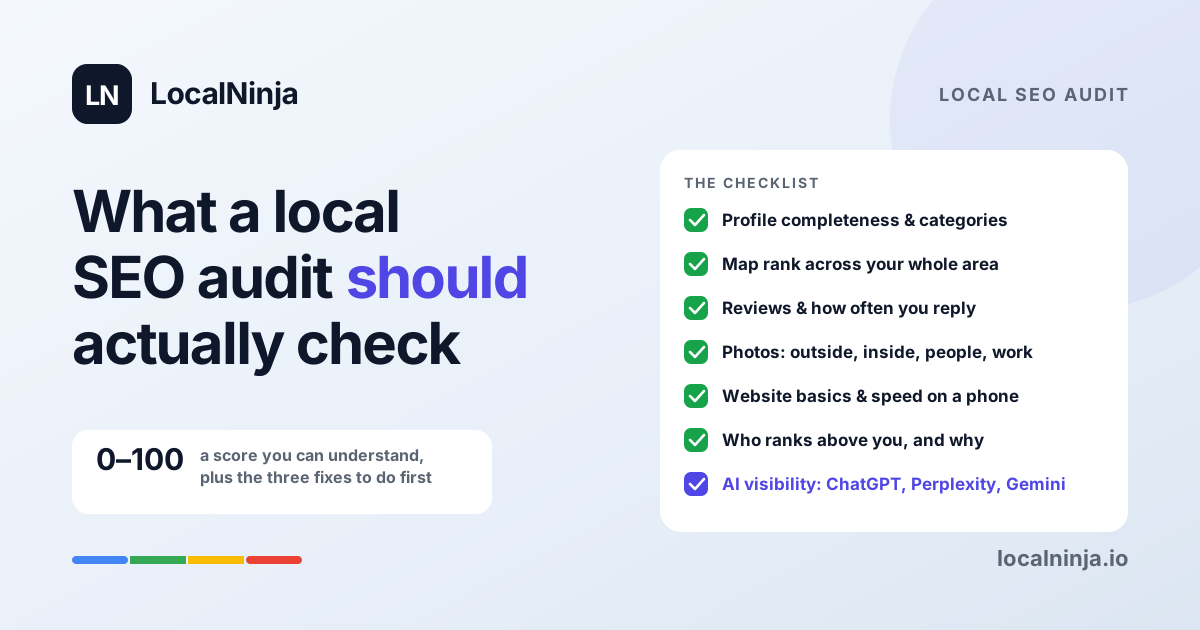
- Profile completeness and categories. Is the primary category the one your customers would use? Are secondary categories, services, hours, description and attributes filled in? A missing or generic category is the most common reason a solid business is hard to find.
- Google Maps ranking across your area. Not one rank from one spot, but a grid of check points across the neighbourhoods you serve, because rank changes block by block. The audit should show you where you are in the top 3, where you drop off, and in which direction.
- Reviews and reply rate. Your rating and count next to the businesses above you, how recent your last reviews are, and how often the owner replies. A profile with no replies reads as unattended, to customers and to Google.
- Photos. How many, how recent, and whether they show the four things people look for: the outside, the inside, the people, and the work.
- Website basics and speed. Does the site say the same name, address and phone as the profile? Does it load quickly on a phone? Does it name the services and the area in plain text?
- The competitors ranking above you, and why. Side by side: their reviews, rating, photos and categories against yours, so the gap has a reason you can act on.
- Guideline risk. Anything on the listing that could trip a suspension — a stuffed name, a mismatched address, a category that does not fit the business.
- AI visibility. Newer, and now part of a complete audit: how often ChatGPT, Perplexity and Gemini name your business when someone asks the questions your customers ask. The only honest way to know is to ask them and count.
What it should hand you at the end
Data without a verdict is homework. A useful local SEO audit opens with one plain sentence about the single thing costing you the most customers, then a score you can understand (0 to 100, with the reasons behind it), then a short plan: the three things to do first, each with the steps, in order of impact. Everything else — the full grid, the competitor table, the photo and review detail — sits underneath for when you want it. You should be able to keep it, print it, and hand it to whoever helps with your website.
Two more things to look for. Every number should say how it was measured. And when something could not be measured — a point on the map that did not return, a signal that needs your Google login — the report should say so, rather than quietly scoring it as a zero or a pass.
What a local SEO audit costs
There are three ways people pay for this. An agency usually folds the audit into a monthly retainer, so the audit is “free” and you pay for it every month whether or not anything changes on your listing. Software suites sell it as a subscription, roughly $25 to $140 a month depending on the tool, and the audit is one feature among many built for people who do this for a living. A one-time audit is a single payment for the report and the plan, and then it is yours.
LocalNinja’s audit is $29, paid once — the full online report, the PDF, the map grid, the AI visibility check and the plan. There is no subscription, and nothing more to buy to see your own results. If you later want someone to make the changes for you, that is a separate conversation, and you are not locked into it by buying the audit.
One-time audit or subscription: which makes sense for you?
A subscription earns its keep when you manage several locations, run campaigns for clients, or need rank tracked every week. For an owner with one or two locations, the honest answer is usually simpler: you need to know where you stand, fix the handful of things that matter, and check again a month or two later. A one-time audit does that. If the second audit shows you have done the work and the gaps have closed, you have spent very little. If it shows the same gaps, you know the work was not done — a useful thing to know if you are paying someone else to do it.
How to read your audit without getting lost
- Read the verdict and the score, then stop. Do not open the full grid yet.
- Do the first three fixes in the plan this week. They are ordered by impact, so the top one is worth more than the next five combined.
- Set a reminder for four to six weeks out. Re-run the audit then, and compare the map and the score. Movement on Google is gradual, so a month is the shortest honest window.
Questions to ask before you pay for any audit
- Is it built from my real Google data, or from a template with my name dropped in? Ask to see a sample report for another business.
- Does it show my map rank across my area, or from a single point? One point can look great and hide the fact that you disappear three blocks away.
- Does it need my Google password? It should not. Everything a good audit checks is public.
- Does it explain every number, and say what it could not measure?
- Does it tell me what to do, in order, in words I can follow — or does it hand me forty pages and a phone number?
If you want to see what one looks like, LocalNinja’s profile audit page shows real sections from a sample report — the verdict, the map, the plan and the AI visibility check — so you know exactly what you are getting before you pay.